Chronology of Rugs
Chronology of the rugs
The earliest known flooring created by man is the humble rug.
BC
6000 Evidence of goats and sheep being sheared for wool and hair and then spun and woven.
1480 Egyptian fresco of handloom (discovered in 1953)
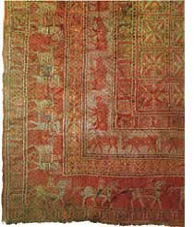
464 Pazyryk rug woven, (Discovered in ice filled tomb Outer Mongolia 1960). It has all the characteristics of a modern Persian or Anatolian with a pile and Ghiordes knot.
AD
1000 Marco Polo confirms rug making in Central Anatolia. From there the technique spread through the Caucasus, Turkomania, Persia, Meshed, Herat, Kabul, India and Kashmir. Samarkand, Bokhara, Tashkent, Sinkiang and Peking were used by Merchants who traded rugs there. The craft swept through Tunisia, Biskra, Bou Saada, Marakesh and Fez.
1537 Robert Rothe imports weavers from the East to make rug on his estate in Kilkenny
1540 Cardinal Wolsey imports Turkie rugs to England
1550 Carpet knotting exhibited by Richard Hickey
1570 Verulam carpet made for Elizabeth 1st
1580 Aubusson carpet centre set up in Beauvair
1586 Ardebil carpet made (now residing in Victoria Albert Museum, London) Made by Maksud the Keshani. (Robinson suggests 1586. Jacobs asserts 1540. One of a pair made for the Mosque of Ardebil. The other is in the Los Angeles Museum of Art).
1596 Pierre DuPont sets up weaving carpets in Palais Royal Paris moves in 1620 to soap works "Savonerie"
1619 Inventory on Naworth Castle mentions Kidderminster Fote Cloths ) "Seven carpets of Kitterminster Stuff").
1655 Carpet factory built at Wilton
1685 Huguenot weavers flee France some settle in England and start weaving in Wilton. Wilton carpet weavers received Royal Charter in 1699.
1720 Earl of Pembroke persuades weavers from Savonnerie factory to work in Wilton and teach locals to make Brussels carpet. (Legend has it that the Duke smuggled the weavers out of France in wine barrels). The Duffossy family still live in Dorset.
1735 Pearsall & Broome set up in Kidderminster making reversible double (Kidder) cloth. The last "Kidder" loom was dismantled in 1936. In 1745 Broome brings weavers from Tournai to Kidderminster to compete with
1749 Dufossy developed method to cut loops of Brussels weave to make a nap. This became known as Wilton carpet.
1750 Peter Parisot sets up carpet weaving in Paddington with two Savonnerie weavers, under patronage of Duke of Cumberland. He moved to larger premises near the Golden Lion Inn in Fulham. In 1755 the factory was brought by Passavant who moved plant to Exeter. (The Golden Lion still exists and when I last visited the hostelry in 1979 there were a couple of topless dancers working the bar).
1755 Moore opened in Moorfield and Whitty opened in Axminster closing in 1835 and looms moved to Wilton. Original hand knotted looms still in operation at Wilton until 1957
1756 - 1759 Royal Society of Arts presented premiums for finest carpets. Won by Whitty three times and Passavant once.
1770 - 1790 Hand made carpet making flourished and attracted designers such as the Adam Brothers and Laverton.
1770 Brintons, previously cloth makers, started making carpets. The dynasty still exists and is the largest privately owned carpet company in the UK. (1997).
1790 Whitty makes carpet for Throne Room at Carlton House and Brighton Pavilion and supplied £1000 carpet to Sultan of Turkey. Coals to Newcastle. It became the fashion to match carpets to ceilings, a trend that is still followed by today's equivalent of Whitty's factory, Axminster Carpets of Devon.
1801 Jacquard invents method of presenting different coloured yarn to weaving face. Revolutionises patterned fabric making the system still in use. (1997)
1810 Decline in fine hand made carpets due to Napoleonic War and competition from machine made. More looms introduced in Kidderminster, Yorkshire and Scotland.
1824 Three ply fabric commenced in Kilmarnock.In America, hand knotted rugs and rag rugs made plus imports from England. In 1791 Sprague opens carpet factory in Philadelphia and 1825 mill opened in Massachusetts.
1750 - 1850 Industrial development in England. Population increase from 7 million to 18 million. End of cottage industries. Industrial revolution brought textile inventions by Hargreaves, Arkwright, Crompton. Cartwright and Watt's steam engine.
1803 Crossley Carpets start in Halifax (Crossley Carpets are still made under Carpets International brand by new owners Shaw Carpets of USA. Decendents of Crossley still make carpets in Yorkshire)
1832 Whytock invents method to print yarn and then weave it into flat fabric with design incorporated. Tapestry Carpet Loom. Start of Henry Widnell Stewart Ltd in Edinburgh later bought by stoddard - who still manufacture carpet.
1837 James works with Quigley to perfect the Chenille Axminster loom. Chenille expanded to meet demand for large seamless patterned carpets at an economic price. Chenille eventually succumbed in 1968. It grew to a multi-million company over 150 years and were bought by Stoddard around 1970. Quigley took his share and disappeared in America around 1850.
1839 Erasmus Bigelow in America invents power loom to make double ingrain and sold it to Scottish and English manufacturers who installed steam power. In 1951 he introduced a steam powered Brussels loom at the Great Exhibition and demonstrated it at Hoobrook in Kidderminster .
1852 William Grosvenor built steam driven factory in Green Street, Kidderminster, where the company still occupies in a listed building.
1862 Alfred Stoddard, an American, took over the tapestry factory of Ronalds at Elderslie, near Glasgow, to make carpets. By 1867 he was selling 75% in America. Stoddard now owns and still make carpets on the original site.
1878 Spool Axminster, invented by Halcyon Skinner in America, introduced into England by Tomkinson and Adam in Kidderminster. (Both families still making carpets - 1997). Morris opened hand knotting factory Hammersmith. (Morris designs still produced on Wilton looms see Hand Made Carpets pages).
1880 William Gray of Ayr develops seamless Kidder carpets
1890 Brintons develop Gripper Axminster (also from Halcyon Skinner of Yonkers) with efficiency advantages over traditional Spool. Later the two techniques were combined in Spool-Gripper.
1896 Donegal hand made factory set up and still in operation. (1997)
1905 Brintons produce carpet from first power driven wide loom. 15 ft wide. (4.57m)
1927 David Crabtree, loom builders since 1853, start to export wide Gripper looms, three yards or three metres wide. 10 ft 6in introduced in 1932.
1930 Decline in Tapestry carpet in favour of huge increase in Gripper Axminster especially for "Seamless Squares".
1940 - 50 Tufted carpets developed in USA from candlewick weaving techniques.
1960 Chenille Axminster disappeared under avalanche of tufted carpet.
1950 - 1970 Tufted carpet limited to plan yarn effects but gradually printing white carpet improved.
1970 - 1995 Woven Carpet production declined by 70% but tufted production increased by 300% (UK).
1995 Fully patterned tufted carpets produced in England by Ryalux Carpets. Individual coloured yarns presented to substrate effectively for the first time. Patterned tufted carpet produced to rival woven (Gripper Axminster and Figured Wilton) carpets.
2000 Carpet choice has never been so diverse. Identifying the need to move with the changing demands of the consumer, the carpet manufacturers across the world offer a huge variety of diverse carpet ranges. 1000’s of textures, colours, designs and styles leave no stone unturned.
To buy rugs online or to view the rugscyclopedia section please click to go to www.latifrugs.com
The earliest known flooring created by man is the humble rug.
BC
6000 Evidence of goats and sheep being sheared for wool and hair and then spun and woven.
1480 Egyptian fresco of handloom (discovered in 1953)
464 Pazyryk rug woven, (Discovered in ice filled tomb Outer Mongolia 1960). It has all the characteristics of a modern Persian or Anatolian with a pile and Ghiordes knot.
AD
1000 Marco Polo confirms rug making in Central Anatolia. From there the technique spread through the Caucasus, Turkomania, Persia, Meshed, Herat, Kabul, India and Kashmir. Samarkand, Bokhara, Tashkent, Sinkiang and Peking were used by Merchants who traded rugs there. The craft swept through Tunisia, Biskra, Bou Saada, Marakesh and Fez.
1537 Robert Rothe imports weavers from the East to make rug on his estate in Kilkenny
1540 Cardinal Wolsey imports Turkie rugs to England
1550 Carpet knotting exhibited by Richard Hickey
1570 Verulam carpet made for Elizabeth 1st
1580 Aubusson carpet centre set up in Beauvair
1586 Ardebil carpet made (now residing in Victoria Albert Museum, London) Made by Maksud the Keshani. (Robinson suggests 1586. Jacobs asserts 1540. One of a pair made for the Mosque of Ardebil. The other is in the Los Angeles Museum of Art).
1596 Pierre DuPont sets up weaving carpets in Palais Royal Paris moves in 1620 to soap works "Savonerie"
1619 Inventory on Naworth Castle mentions Kidderminster Fote Cloths ) "Seven carpets of Kitterminster Stuff").
1655 Carpet factory built at Wilton
1685 Huguenot weavers flee France some settle in England and start weaving in Wilton. Wilton carpet weavers received Royal Charter in 1699.
1720 Earl of Pembroke persuades weavers from Savonnerie factory to work in Wilton and teach locals to make Brussels carpet. (Legend has it that the Duke smuggled the weavers out of France in wine barrels). The Duffossy family still live in Dorset.
1735 Pearsall & Broome set up in Kidderminster making reversible double (Kidder) cloth. The last "Kidder" loom was dismantled in 1936. In 1745 Broome brings weavers from Tournai to Kidderminster to compete with
1749 Dufossy developed method to cut loops of Brussels weave to make a nap. This became known as Wilton carpet.
1750 Peter Parisot sets up carpet weaving in Paddington with two Savonnerie weavers, under patronage of Duke of Cumberland. He moved to larger premises near the Golden Lion Inn in Fulham. In 1755 the factory was brought by Passavant who moved plant to Exeter. (The Golden Lion still exists and when I last visited the hostelry in 1979 there were a couple of topless dancers working the bar).
1755 Moore opened in Moorfield and Whitty opened in Axminster closing in 1835 and looms moved to Wilton. Original hand knotted looms still in operation at Wilton until 1957
1756 - 1759 Royal Society of Arts presented premiums for finest carpets. Won by Whitty three times and Passavant once.
1770 - 1790 Hand made carpet making flourished and attracted designers such as the Adam Brothers and Laverton.
1770 Brintons, previously cloth makers, started making carpets. The dynasty still exists and is the largest privately owned carpet company in the UK. (1997).
1790 Whitty makes carpet for Throne Room at Carlton House and Brighton Pavilion and supplied £1000 carpet to Sultan of Turkey. Coals to Newcastle. It became the fashion to match carpets to ceilings, a trend that is still followed by today's equivalent of Whitty's factory, Axminster Carpets of Devon.
1801 Jacquard invents method of presenting different coloured yarn to weaving face. Revolutionises patterned fabric making the system still in use. (1997)
1810 Decline in fine hand made carpets due to Napoleonic War and competition from machine made. More looms introduced in Kidderminster, Yorkshire and Scotland.
1824 Three ply fabric commenced in Kilmarnock.In America, hand knotted rugs and rag rugs made plus imports from England. In 1791 Sprague opens carpet factory in Philadelphia and 1825 mill opened in Massachusetts.
1750 - 1850 Industrial development in England. Population increase from 7 million to 18 million. End of cottage industries. Industrial revolution brought textile inventions by Hargreaves, Arkwright, Crompton. Cartwright and Watt's steam engine.
1803 Crossley Carpets start in Halifax (Crossley Carpets are still made under Carpets International brand by new owners Shaw Carpets of USA. Decendents of Crossley still make carpets in Yorkshire)
1832 Whytock invents method to print yarn and then weave it into flat fabric with design incorporated. Tapestry Carpet Loom. Start of Henry Widnell Stewart Ltd in Edinburgh later bought by stoddard - who still manufacture carpet.
1837 James works with Quigley to perfect the Chenille Axminster loom. Chenille expanded to meet demand for large seamless patterned carpets at an economic price. Chenille eventually succumbed in 1968. It grew to a multi-million company over 150 years and were bought by Stoddard around 1970. Quigley took his share and disappeared in America around 1850.
1839 Erasmus Bigelow in America invents power loom to make double ingrain and sold it to Scottish and English manufacturers who installed steam power. In 1951 he introduced a steam powered Brussels loom at the Great Exhibition and demonstrated it at Hoobrook in Kidderminster .
1852 William Grosvenor built steam driven factory in Green Street, Kidderminster, where the company still occupies in a listed building.
1862 Alfred Stoddard, an American, took over the tapestry factory of Ronalds at Elderslie, near Glasgow, to make carpets. By 1867 he was selling 75% in America. Stoddard now owns and still make carpets on the original site.
1878 Spool Axminster, invented by Halcyon Skinner in America, introduced into England by Tomkinson and Adam in Kidderminster. (Both families still making carpets - 1997). Morris opened hand knotting factory Hammersmith. (Morris designs still produced on Wilton looms see Hand Made Carpets pages).
1880 William Gray of Ayr develops seamless Kidder carpets
1890 Brintons develop Gripper Axminster (also from Halcyon Skinner of Yonkers) with efficiency advantages over traditional Spool. Later the two techniques were combined in Spool-Gripper.
1896 Donegal hand made factory set up and still in operation. (1997)
1905 Brintons produce carpet from first power driven wide loom. 15 ft wide. (4.57m)
1927 David Crabtree, loom builders since 1853, start to export wide Gripper looms, three yards or three metres wide. 10 ft 6in introduced in 1932.
1930 Decline in Tapestry carpet in favour of huge increase in Gripper Axminster especially for "Seamless Squares".
1940 - 50 Tufted carpets developed in USA from candlewick weaving techniques.
1960 Chenille Axminster disappeared under avalanche of tufted carpet.
1950 - 1970 Tufted carpet limited to plan yarn effects but gradually printing white carpet improved.
1970 - 1995 Woven Carpet production declined by 70% but tufted production increased by 300% (UK).
1995 Fully patterned tufted carpets produced in England by Ryalux Carpets. Individual coloured yarns presented to substrate effectively for the first time. Patterned tufted carpet produced to rival woven (Gripper Axminster and Figured Wilton) carpets.
2000 Carpet choice has never been so diverse. Identifying the need to move with the changing demands of the consumer, the carpet manufacturers across the world offer a huge variety of diverse carpet ranges. 1000’s of textures, colours, designs and styles leave no stone unturned.
To buy rugs online or to view the rugscyclopedia section please click to go to www.latifrugs.com